

 Canadian Dollars
 US Dollar
 Mexican Peso
 Euro
Euro
 British Pound
 Australian Dollar
Window Opening Safety in Ontario: Limiters, Guards, Screens, Glass & the 100 mm Reference
Windows provide light, ventilation and—in some rooms—an emergency escape route. They can also present a fall hazard when an opening is accessible and the exterior drop is significant. This guide explains window sash limiters, guards, screens, glazing and the commonly referenced 100 mm opening in clear, non-technical language.
It is written for property managers, condominium corporations, landlords, homeowners, builders, installers and families who need to assess an existing window or plan a safer opening-control program.
Last reviewed: August 20, 2026 · Ontario-focused general information
Missing, damaged or disabled window protection?
Keep children and vulnerable occupants away from the area, move climbable furniture away from the window, and arrange a prompt assessment. In a rental or condominium building, report the condition to the responsible property manager, owner or condominium corporation. Do not improvise a repair that blocks a required emergency exit or risks damaging the glass.
1. Why window opening safety matters
A fall can occur quickly when an accessible window opens far enough for a small child or another vulnerable person to pass through it. Warm weather, open windows and nearby furniture can increase the opportunity for access.
Recent official safety reminders have emphasized several practical measures: use appropriate locks or guards, do not rely on ordinary insect screens, keep climbable furniture away from windows, supervise young children and check that safety devices continue to function. These measures work together; no single piece of hardware should be treated as a complete safety system.
Use calm, accurate language
Terms such as childproof, fall-proof and guaranteed safe can create false confidence. A better description is that suitable hardware can help limit an opening when it is correctly selected, installed, tested, maintained and used as part of a broader safety plan.
2. Four separate safety layers
People often use the phrase “window safety” to describe different hazards. Separating them makes it easier to choose the correct response.
Sash-opening control
A limiter, restrictor or control device addresses how far the operable part of a window can move.
Screens or guards
An insect screen, heavy-duty protective screen and structural guard are not interchangeable products.
Glass and glazing
Safety glazing addresses human-impact and breakage behaviour. It does not limit an open sash.
Room and occupant factors
Furniture placement, supervision, window access, maintenance and emergency escape all affect risk.
| Component or measure | What it addresses | What it does not establish by itself |
|---|---|---|
| Sash limiter or restrictor | Travel of a compatible operable sash when the device is engaged. | Glass performance, guard capacity, screen strength, egress suitability or code compliance. |
| Ordinary insect screen | Primarily keeps insects and debris out. | Reliable fall resistance or child fall protection. |
| Heavy-duty protective screen | May form part of a prescribed or engineered protection system when it meets the required standard. | Universal suitability for every opening or municipality. |
| Guard | A protective barrier intended to reduce accidental falls from one level to another. | Window operation or emergency-escape suitability unless those matters are addressed in the design. |
| Safety glazing | Human-impact and breakage performance in applicable locations. | A restriction on how far an operable window can open. |
3. Window types and sash limiters
A limiter must match the motion and construction of the window. A device that works on a sliding sash may be unsuitable for a projected or hinged sash.
Conceptual movement only. The red components show possible stop locations, not universal installation positions.
Horizontal sliding windows
One or more sashes move left or right in tracks. A compatible stop may be positioned in the sash path to limit travel. Check the meeting rails, interlocks, weather seals, glass edge and frame cavities before drilling.
Vertical hung windows
A lower or upper sash moves vertically. A compatible stop may limit upward or downward travel. Check jamb liners, balances, tilt latches, pivot bars, weather seals and concealed hardware before drilling.
Do not assume that a spring-loaded sliding-window sash stop is suitable for casement, awning, hopper, tilt-and-turn or other projected windows. Those windows use different movement, hardware and opening-control methods.
4. What does “100 mm” or “4 inches” mean?
One hundred millimetres is approximately 3.94 inches, so it is commonly described as “about four inches.” The figure appears in several window-opening and guard-related requirements, but context matters.
It is an opening measurement
The relevant measurement is generally the clear space through which something could pass—not the length of the limiter itself.
It is not built into this part
A sash stop creates an opening based on where it is installed and the geometry of the window. Measure after installation.
It is not universal
The applicable rule can depend on occupancy, sill height, exterior drop, municipality, egress and other conditions or exceptions.
Do not select a part only because it is advertised as a “4-inch window lock”
The resulting opening depends on the window and installation. A code or by-law may also require a guard, protective screen, tested device, specific release method or other design features that a basic sash stop does not provide.
5. Ontario Building Code context
Ontario’s Building Code contains requirements for openable windows and guards in specified circumstances. The exact application must be determined from the current Code, the building and the proposed use of the window.
The Ontario Building Officials Association’s Building Code Advisory Services published a 2025 advisory about Window Opening Control Devices. It summarizes the 2024 Ontario Building Code as addressing certain residential windows with low sill heights by requiring protection through a guard or an opening-control mechanism that limits the opening to not more than 100 mm. It also discusses the difficult interaction between fall protection and a window that is required to provide emergency escape.
The advisory is not legislation and expressly states that final interpretation rests with the local Authority Having Jurisdiction (AHJ). In practice, the AHJ is typically the municipal building department or other authority responsible for applying the relevant requirement to the project.
Why the product page does not claim “Ontario Building Code compliant”
Compliance is not a property of a small part in isolation. It depends on the exact device, supporting documentation, window, building, installation, clear opening, release method, egress role and acceptance by the applicable authority. Unless a manufacturer supplies relevant test and certification documents for the exact product, a basic sash stop should not be marketed as an ASTM F2090-compliant WOCD.
6. Toronto apartment requirements: read the detailed provision
The City of Toronto publishes a helpful 311 summary about window safety latches. Property owners and managers should also review the more detailed wording in the consolidated Municipal Code.
The consolidated Chapter 629 document available online is dated April 30, 2025. Its apartment-window provision addresses windows in dwelling units that are more than 2,000 mm above grade and open within 1,500 mm of the floor, subject to an exception for a full-length exterior balcony. It describes protection by:
- a conforming guard;
- a controlled sash operation restricting the opening, when engaged, to not more than 100 mm and a heavy-duty screen conforming to CAN/CSA A440; or
- an alternative device that does not reduce the degree of safety provided by those options.
This is important because a basic sash limiter alone should not be assumed to satisfy the controlled-sash option. Property managers should verify the current consolidated by-law and obtain direction from Toronto Municipal Licensing & Standards or another qualified authority for the particular building and condition.
7. Emergency-egress considerations
A window that is expected or required to provide emergency escape must remain usable for that purpose. Adding a limiter can solve one hazard while creating another if the release method or remaining opening prevents escape.
Questions to ask before restricting the opening
- Is this window required for emergency escape from the room?
- Can the required clear opening still be achieved?
- Can an occupant operate the release in an emergency?
- Does the release require a key, tool or specialized knowledge?
- Has the proposed device and installation been accepted by the AHJ where required?
Do not rely on assumptions
A product described online as a “quick-release limiter” is not automatically suitable for a required egress window. The exact standard, release sequence, testing, installation and local acceptance matter. Where egress is involved, obtain a project-specific assessment rather than adapting a generic sash stop.
8. A practical window-safety inspection program for property managers
A consistent process is more reliable than responding only when a tenant reports a missing latch. The following framework can be adapted to the building and advice from qualified professionals.
- Create a window inventory. Record building, unit, room, elevation, window type and unique window identifier.
- Group actual window profiles. Do not assume every opening in a building uses the same sash, frame or concealed hardware.
- Record the exterior condition. Note the approximate drop, balcony relationship and surrounding conditions.
- Record interior accessibility. Note sill height, nearby furniture and whether children or vulnerable occupants may access the opening.
- Identify the existing protection. Record limiters, guards, screen type, release method and any missing or altered components.
- Measure the opening. With the device engaged, measure and record the widest clear passable opening.
- Test normal operation. Cycle the sash and verify that the device remains secure and functions consistently.
- Inspect the mounting. Look for loose fasteners, rotation, deformation, damaged substrate, corrosion or improvised repairs.
- Assess egress and ventilation. Flag any window that may have an emergency-escape, fire-safety or required ventilation role.
- Photograph and document. Keep dated photos and a record of the device, measurement, inspector and corrective action.
- Set reinspection triggers. Include tenant turnover, window repair, reported tampering, missing hardware and scheduled reviews.
- Escalate uncertainty. Send code, guard, egress, structural and unusual installation questions to the appropriate professional or AHJ.
Keep a device register
For larger portfolios, assign each limiter or protective system a record with the window ID, product, installer, installation date, measured opening, photographs, inspection dates and deficiencies. This makes missing or disabled hardware easier to identify and helps demonstrate that the system is being maintained.
9. Practical actions for families and residents
Hardware is only one part of the environment. These simple measures reduce access and help identify problems early.
Around windows
- Keep beds, cribs, chairs, storage bins and other climbable furniture away from windows.
- Do not encourage sitting, leaning or playing on window sills.
- Do not rely on an ordinary insect screen to support body weight or prevent a fall.
- Check that limiters, locks and guards are present, secure and functioning.
When something is wrong
- Report missing, loose, damaged or disabled devices promptly.
- Do not remove or bypass a safety device for convenience.
- Do not drill near glass or concealed hardware without understanding the window construction.
- Do not permanently block a window that may be required for emergency escape.
10. When a spring-loaded, double-drilled sash limiter may be relevant
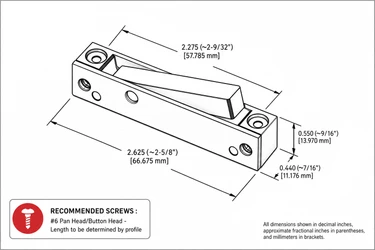
Ontario Glazing Supplies carries a compact spring-loaded limiter traditionally used with compatible horizontal sliding and vertical hung windows. “Double drilled” describes top- and side-mounting hole options; it does not mean double locking.
Potentially relevant where
- The sash slides horizontally or vertically.
- The moving sash can contact a stop in a suitable location.
- A solid mounting substrate is available.
- Glass and concealed hardware are clear of the drilling area.
- The intended opening can be measured and verified.
- The device will not conflict with a required emergency-escape function.
Not enough by itself where
- A guard, tested protective screen or complete engineered system is required.
- The window is casement, awning, hopper, projected or tilt-and-turn.
- The frame is damaged, thin, deteriorated or lacks adequate substrate.
- The primary concern is glass impact, glass retention or structural loading.
- The device must satisfy a specific standard or certification not documented for the product.
- The proposed installation could obstruct required egress.
Review the full product application notes before ordering: Spring-Loaded Window Sash Limiter for Sliding & Hung Windows — SKU SL-5901DD.
11. Frequently asked questions
Are window screens designed to prevent falls?
Ordinary insect screens are not designed to act as fall barriers and should not be relied on for that purpose. A heavy-duty screen required as part of a particular regulatory or engineered system is a different product with different performance requirements.
Does tempered or safety glass prevent someone from falling through an open window?
No. Safety glazing addresses impact and breakage behaviour in applicable locations. It does not restrict an open sash or replace a guard or other required opening protection.
Do all Ontario windows have to be limited to 100 mm?
No blanket statement should be made. Ontario and municipal requirements apply in defined circumstances and can include conditions, exceptions and alternative forms of protection. Confirm the current rule for the exact building and window.
Is a “window safety lock” the same as a security lock?
Not necessarily. A sash limiter may control opening travel but may not be designed or tested as a primary forced-entry security lock. Confirm the intended function and supporting documentation for the exact product.
Can a property manager install the same limiter on every window in a building?
Only after the window types and mounting conditions have been verified. Buildings often contain multiple generations of windows, replacement sashes, different profiles and concealed hardware. Pilot the application on each distinct window type, document the result and measure the opening.
How often should window limiters be inspected?
The appropriate schedule depends on the building and risk assessment. At minimum, inspect after installation, after window work, at tenant turnover, after any report of tampering or damage, and on a documented periodic schedule established by the property owner or qualified advisor.
What photographs should I send for hardware identification?
Send a full interior view of the window, a clear view of how the sash moves, close photographs of the proposed mounting area, relevant measurements, any existing device, and the quantity and municipality. A close-up of a loose part alone is usually not enough to assess application.
Need help identifying a limiter for a sliding or hung window?
Ontario Glazing Supplies can help compare the hardware and window profile, review product availability and discuss bulk requirements. Product-identification assistance does not replace an on-site code, fire-safety, engineering or installation assessment.
12. Authoritative sources and further reading
- Government of Ontario — 2024 Ontario Building Code. Check the current adopted Code and amendments.
- OBOA Building Code Advisory Services — Window Opening Control Devices. Advisory discussion of opening control, fall protection and egress.
- OBOA Building Code Advisory Services — Guard Requirements for Windows in a Part 9 Building. Advisory discussion distinguishing openable-window protection, guards and glazing.
- City of Toronto — Window Safety Latches. Public-facing 311 summary and reporting information.
- City of Toronto — Municipal Code Chapter 629, Property Standards. See the current consolidated text, including the detailed apartment-window provision.
- Ottawa Police Service — Window and Balcony Safety Reminder. Practical measures concerning locks, guards, screens, furniture, supervision and inspection.